One of the most common questions we hear from business owners — especially those who have recently registered or are growing beyond the stage where they could manage everything themselves — is simply: "What exactly am I supposed to be paying?"
It is a fair question. Kenya's tax framework involves several distinct obligations, and which ones apply to your business depends on your legal structure, your revenue, whether you have employees, and the nature of your operations. The businesses that stay compliant without stress are those that understand their specific obligations early — rather than discovering gaps during an audit or review.
The Core Tax Types Every Business Should Know
Here is a clear overview of the main taxes that affect Kenyan businesses, and the conditions under which each one applies:
Corporate Income Tax (CIT)
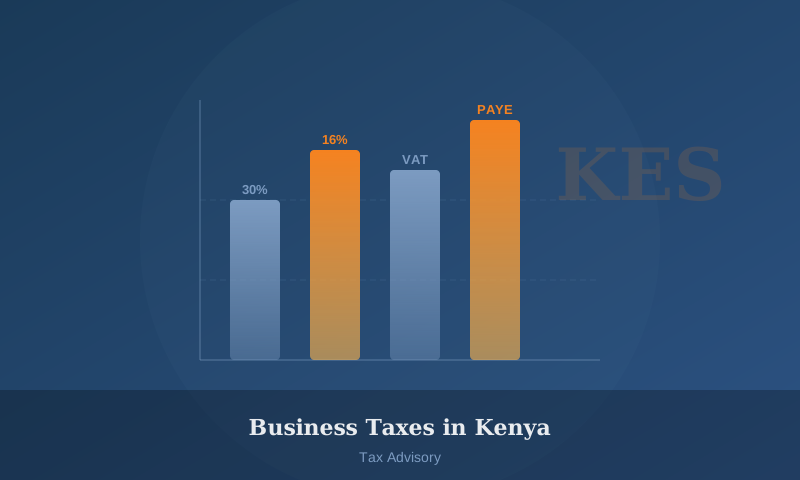
Applies to companies on their taxable profits. The standard rate is 30% for resident companies and 37.5% for non-resident companies with a Kenyan permanent establishment. Filed annually.
Value Added Tax (VAT)
Applies once your taxable turnover exceeds KES 5 million per year. The standard rate is 16%, applied to most goods and services. VAT returns are filed and paid monthly.
Pay As You Earn (PAYE)
Applies to any business with employees. As the employer, you are responsible for deducting income tax from employee salaries and remitting it to KRA by the 9th of each month.
Withholding Tax (WHT)
Applies when you pay certain service providers, consultants, or suppliers. Rates vary (typically 5%–20% depending on the payment type). You deduct it at source and remit to KRA.
Turnover Tax (TOT)
An alternative to corporate income tax for businesses with annual turnover between KES 1 million and KES 50 million. Taxed at 3% of gross turnover. Simpler to administer than CIT.
Advance Tax & Instalment Tax
Businesses expected to owe more than KES 40,000 in annual income tax are required to pay quarterly instalments during the year rather than a single annual payment.
Also Consider
Depending on your sector, additional levies may apply — including the Housing Levy (1.5% of gross salary), NSSF contributions, NHIF deductions, and sector-specific fees such as those levied by NEMA, county authorities, or regulatory bodies. These are not managed through KRA but are still legal obligations.
Where Most Businesses Get It Wrong
Compliance issues for businesses in Kenya rarely stem from deliberate avoidance. They usually come from three specific gaps:
- Not knowing what applies to them. A freelancer who registers a company may not realise they have shifted from individual income tax to corporate tax obligations. A business crossing the VAT threshold may not register in time.
- Filing the right returns but filing them incorrectly. Errors in VAT input claims, incorrect PAYE calculations, or missed WHT deductions often only surface during audits — long after they were made.
- Missing secondary obligations. Many businesses focus on the main returns and overlook ancillary ones, such as withholding tax certificates, which are legally required to be issued to service providers you have deducted WHT from.
Understand Your Position
Not sure which taxes apply to your business?
We map your specific obligations based on your business type, size, and operations — so there are no surprises.
How to Get Clarity on Your Own Obligations
You do not need to become a tax expert. What you do need is a clear, accurate picture of what applies to your specific business. Here is how to build that:
- Start with your legal structure. A sole proprietorship, partnership, and limited company each have different income tax treatments. If your structure has changed, your tax obligations may have changed too.
- Check your KRA registration. Log in to iTax and review which tax types your PIN is registered for. If VAT, PAYE, or other obligations are not active but should be, that is a registration issue to address now rather than later.
- Review your turnover. If your annual revenue is approaching or has passed KES 5 million, VAT registration becomes mandatory. If it is below KES 50 million, TOT may be more appropriate than standard CIT.
- Assess your payroll. If you have any employees — including directors drawing salaries — PAYE applies. There is no minimum salary threshold below which PAYE is optional.
- Audit your supplier payments. Review what you are paying external service providers and whether WHT should be deducted. If it should have been and was not, the liability rests with you as the payer.
- Get a professional compliance review. A structured review of your current position — covering all tax types — identifies what is correct, what is missing, and what needs to be fixed before it becomes a problem.
- Most Kenyan businesses are subject to multiple tax types — not just income tax.
- Which taxes apply depends on your legal structure, turnover, and whether you have employees.
- VAT registration is mandatory once turnover exceeds KES 5 million per year.
- PAYE applies to every business with employees — there is no minimum salary threshold.
- Compliance gaps are almost always easier and less costly to fix proactively than reactively.
Compliance is a System, Not a Guessing Game
The businesses that manage their tax obligations cleanly are not necessarily the largest or most sophisticated. They are the ones that took the time to understand their specific position, set up the right processes, and review those processes as the business grows.
If you have been operating without a clear picture of your full tax obligations, the right time to build that picture is now — not when a KRA notice arrives. Getting clarity early is one of the most cost-effective things you can do for your business.